

Manisha Modi
Content Strategist & Writer
How to Use AI Screening Calls to Qualify 100 Candidates Without a Single Call
Picture two recruiters on a Monday morning. One opens a folder of 500 fresher applications for a single opening and starts the ritual: skim, dial, wait for voicemail, dial again, take notes on a call that goes nowhere, hang up, repeat. By Friday, they have spoken to 40 people and qualified nine.
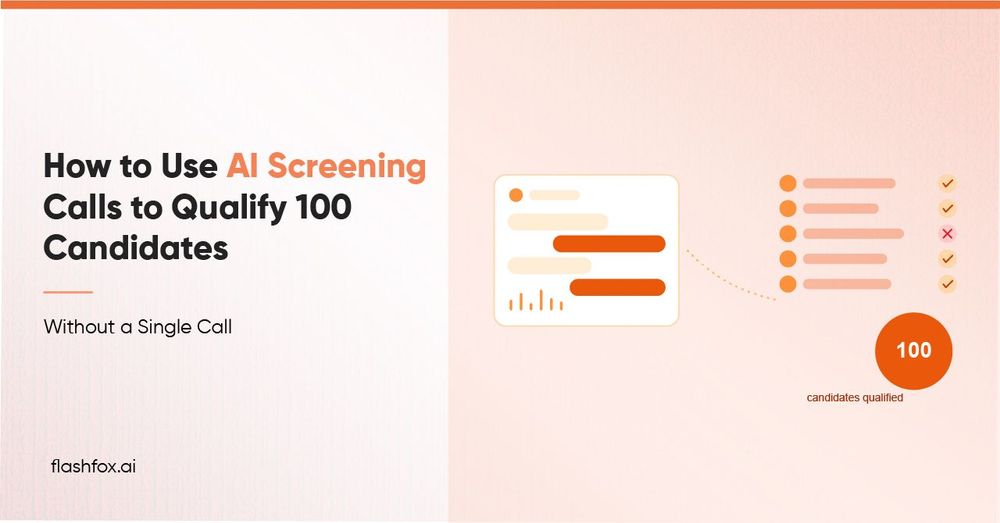
The other recruiter opens a dashboard. Overnight, an AI system placed structured calls to all 500 candidates, asked every one of them the same qualifying questions, scored their answers against the role’s must-haves, and sorted the pool into “advance,” “hold,” and “reject,” with a transcript and a reason attached to each decision. They spend their Monday talking to the nine best candidates, not screening for them.
That second workflow is what AI screening calls for recruitment actually looks like in 2026, and it’s the subject of this guide: how to use it to qualify 100 candidates without picking up the phone once.
This isn’t a theoretical exercise. Screening is the single most time-consuming, least differentiated part of hiring. And it’s also the stage where AI adoption is running furthest ahead of the rest of the recruiting stack. According to Aptitude Research and iCIMS’ Definitive Guide to AI in Talent Acquisition, screening is the leading AI use case among adopters, ahead of candidate communication, assessments, and sourcing. If you’re going to bring AI into your hiring process anywhere first, this is where the return shows up fastest.
Why Manual Phone Screening Doesn’t Scale Past a Handful of Roles
Before looking at what AI screening calls do differently, it’s worth being precise about what manual screening actually costs, because most hiring teams underestimate it badly.
A single phone screen isn’t just the 15-30 minutes on the call. Once you add scheduling back-and-forth, no-shows, and note-taking, research from Hireology puts the real cost at roughly $12-14 in recruiter time per candidate, based on a realistic 25-30 minute block per screen. InterviewCost.com’s five-component model, which includes interviewer time, recruiter overhead, tooling, logistics, and reschedule drag, puts the full per-screen time closer to 55 minutes once everything before and after the call is counted.
That adds up fast. A breakdown from talent-ops firm Zivaro shows that for a typical mid-volume role (15-300 applications, one hire), roughly 23 of the 40-plus hours spent per hire go to screening alone. Resume review, phone screenings, and the scheduling and correspondence around them. And recruiter call time isn’t going down. A joint report from the American Staffing Association and Prodoscore, covered by HR Dive, found recruiters logged a record 286 minutes a week on calls with candidates and clients in early 2026. This is exactly double what the same survey measured two years earlier, driven largely by application volumes that have roughly tripled since 2021.
For high-volume fresher and campus hiring, GetWork’s own core market, the stats get more extreme, not less. Fresher postings in India routinely draw 500 to 5,000 applications per role. At two minutes of manual review per resume alone, before a single call is placed, that’s 17 to 167 hours of recruiter time on one opening (Keelzo Research, 2026). No team scales that linearly by hiring more recruiters. The volume outruns the headcount every time.
The screening bottleneck, in numbers
| Metric | Figure | Source |
| Average cost per manual phone screen | $12-14 in recruiter time | Hireology, 2026 |
| Full-time block per screen (including scheduling, notes) | ~55 minutes | InterviewCost.com, 2026 |
| Recruiter time spent on screening per hire | ~23 hours | Zivaro, 2026 |
| Recruiter weekly call time (early 2026) | 286 minutes, 2x YoY | ASA/Prodoscore via HR Dive, 2026 |
| Applications per fresher opening in India | 500-5,000 | Keelzo Research, 2026 |
| Manual resume screening time for one such role | 17-167 hours | Keelzo Research, 2026 |
| Candidates ghosted by employers in the past year | 53% (3-year high) | Criteria Corp/Fortune, 2026 |
That last row matters as much as the cost figures. Slow, manual screening isn’t just expensive; it’s a direct driver of candidate ghosting. When response times stretch to days or weeks, candidates disengage, and employer-side ghosting has now hit a three-year peak. Speed of first response has become a competitive signal, not a courtesy.
What AI Screening Calls Actually Are
An AI screening call is an automated, voice- or chat-based conversation that asks every candidate a structured set of qualifying questions. Their availability, must-have skills, salary expectations, notice period, work authorization, and role-specific knowledge checks. It scores the responses consistently against criteria set by the recruiter before a human ever gets involved.
The mechanics are simple, but the effect on the funnel is not:
- Every candidate gets the same questions, asked the same way, removing the variability that creeps in when a tired recruiter is on their 30th call of the day.
- Responses are transcribed and scored in real time, so the recruiter reviews a ranked shortlist instead of a stack of resumes and a notebook of scattered notes.
- Screening happens 24/7, so a candidate who applies at 11 pm can complete a screen before the recruiter’s next shift starts, closing the exact response-time gap that drives ghosting.
- Nothing moves forward without a defined threshold being met, so recruiters spend their time on conversations that matter: negotiation, culture fit, and closing instead of qualification.
This is consistent with what MIT Sloan’s research on hybrid human-AI hiring found. The strongest outcomes come from AI handling repetitive screening and data processing while humans retain the judgment calls, and not from removing humans from the loop altogether.
How to Use AI Screening Calls to Qualify 100 Candidates at Scale
Here’s the actual workflow, step by step.
1. Define the qualifying criteria before you turn on automation
AI screening is only as good as the questions and thresholds you give it. Before qualifying a single candidate, lock down:
- The 4-6 non-negotiable must-haves for the role (skills, certifications, experience band, location/remote eligibility)
- Deal-breaker questions (notice period, salary band, work authorization)
- What “advance,” “hold,” and “reject” actually mean in scoring terms
Skipping this step is the single biggest reason AI screening implementations underperform. The tool automates whatever criteria you feed it, including vague ones.
2. Let the AI system place or receive calls at scale
Once criteria are set, the system works through the applicant pool: outbound calls, inbound callback links, or a structured voice/chat interview triggered the moment someone applies. For a 500-application fresher role, this is the step that used to take 17-167 hours of manual resume review and days of scheduled calls. Automated screening compresses it to a few hours of processing time, because the constraint shifts from recruiter capacity to nothing more than the candidates’ own availability to respond.
3. Review a pre-scored shortlist, not a raw applicant list
Instead of opening an ATS to 500 unranked resumes, the recruiter opens a shortlist ranked by fit score, with the AI’s reasoning and a call transcript attached to every candidate, including the ones who were screened out, for audit and fairness review.
4. Route only qualified candidates to human interviews
The 90 or so candidates who don’t meet the threshold are notified automatically (closing the ghosting loop from the employer side). The remaining shortlist say, 8-12 out of the original 100 goes straight to the hiring manager or human interview stage. This is where Flashfox’s approach differs from a generic chatbot screen. The AI screening layer inside Flashfox is built to hand off a structured, scored candidate profile directly into the next interview stage, so nothing gets re-explained or re-screened by a human.
5. Feed outcomes back into the model
Track which AI-qualified candidates actually perform well in interviews and on the job, then tighten the qualifying criteria accordingly. This step is what separates a screening tool that gets more accurate over time from one that just automates a static checklist.
AI Screening Calls vs. Manual Phone Screening
| Factor | Manual Phone Screening | AI Screening Calls |
| Time to screen 100 candidates | ~40+ hours (25-30 min/screen) | A few hours of processing, no recruiter time |
| Consistency across candidates | Varies by recruiter energy/time of day | Same questions, same scoring criteria, every time |
| Availability | Business hours only | 24/7 |
| Candidate response time | Days, contributing to ghosting | Instant |
| Recruiter’s role | Conducting every qualifying conversation | Reviewing scored shortlists, running closing conversations |
| Auditability | Handwritten or freeform notes | Transcript + score attached to every decision |
| Cost per candidate screened | ~$12-14 in recruiter time (Hireology) | Marginal cost per additional candidate is near-zero |
Bias, Compliance, and the Human-in-the-Loop Recruitment
No honest guide to AI screening calls for recruitment can skip the regulatory and fairness picture, because 2026 is the year it stopped being optional.
Trust remains the real constraint on adoption of AI, as only 26% of applicants say they trust AI to evaluate them fairly, according to Greenhouse’s 2026 research, even though over half believe it’s already happening.
None of this is a reason to avoid AI screening calls. It’s a reason to implement them correctly:
- Keep a human reviewing edge cases and rejections, not just approvals
- Use structured, job-related questions and not open-ended proxies that can encode bias
- Log every scoring decision so you can audit for disparate impact
- Tell candidates when AI is part of the process; opacity is what erodes trust fastest
Why This Matters More for High-Volume Fresher Hiring
Fresher and campus hiring is where the case for AI screening calls is strongest, because the arithmetic is most extreme. India produces one of the world’s largest annual pools of entry-level talent, and single fresher postings can draw thousands of applications with near-identical resumes on paper. The exact scenario where manual screening degrades faster, and a structured, consistent qualifying call adds the most signal. Platforms like Flashfox are built around this specific bottleneck: taking a fresher-hiring funnel that used to require days of manual dialing and resume sorting, and compressing it into a same-day, scored shortlist a recruiter can act on immediately.
The Bottom Line
The phone screening was never actually about the phone call. It was about answering one question, “Does this person meet the bar?” 100 times over for every 100 applicants. Manual screening answers that question one exhausting conversation at a time. AI screening calls answer it for the entire pool before a recruiter’s coffee gets cold, and hand back exactly the nine or ten conversations that were worth having in the first place.
That’s not fewer conversations with the candidates. It’s the same number of meaningful ones, minus the 490 that were never going anywhere. For teams hiring at fresher and campus scale, where the applicant math is most brutal, that shift is the difference between a hiring funnel that keeps up and one that quietly falls further behind every hiring season. Flashfox exists for exactly that gap: turning a stack of thousands of applications into a shortlist a recruiter can act on the same day.
Frequently Asked Questions
Comments (0)
Leave a comment