

Manisha Modi
Content Strategist & Writer
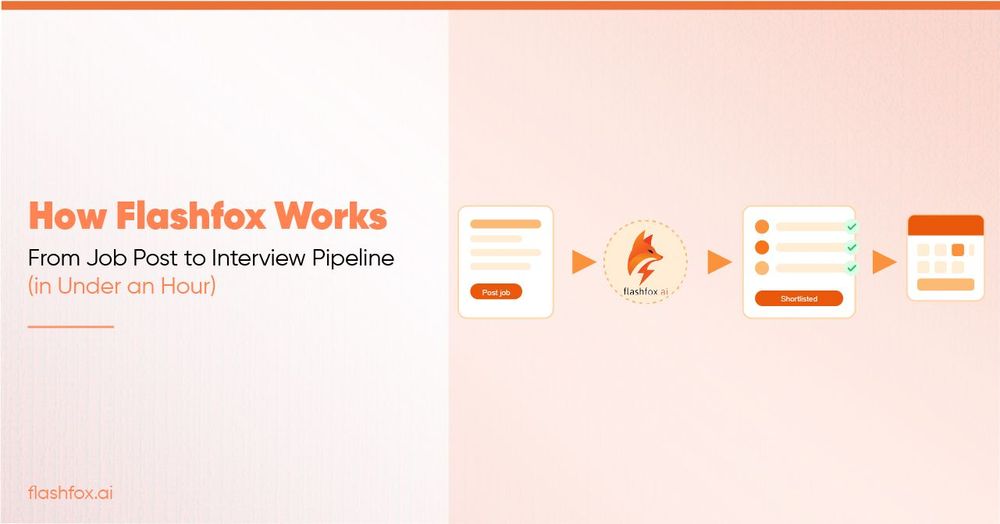
How Flashfox Works From Job Post to Interview Pipeline (in Under an Hour)
It is 9:04 AM. A hiring manager has just approved a new requisition for a Full Stack Developer. By the time most recruiting teams have opened a job board and drafted a Boolean string, the role has already been open for six minutes. By the time they’ve posted it, screened the first batch of resumes, and sent the first “are you available for a call” email, three to five business days have usually gone by. And that’s just to get one candidate on the phone.
Now picture the same requisition on a platform built to automate end-to-end hiring: candidates are found and cross-verified in under 5 minutes, outreach goes out automatically across four channels, a qualified candidate replies, completes an AI screening call, clears a structured AI interview, and books their own F2F interview slot. All this inside a single hour of active processing time. That’s not hypothetical. It’s the workflow Flashfox was built to run.
This piece breaks down exactly how that timeline is possible, what “end-to-end hiring automation” actually means in practice, and where the industry’s real bottlenecks sit, with sourced 2026 data throughout.
What “Automate End to End Hiring” Actually Means
The phrase gets used loosely, so it’s worth defining precisely. End-to-end hiring automation means a single connected system handles every stage of the pipeline. Sourcing, validation, outreach, screening, interviewing, and scheduling without a recruiter manually re-updating candidate information, sending individual follow-up emails, or coordinating calendars by hand between each stage.
It’s different from point-solution automation, where a team stitches together a sourcing tool, a separate outreach sequencer, a chatbot for screening, and a scheduling link, each with its own login, its own data format, and its own handoff gap. Most “AI recruiting” tools on the market today automate one or two of these stages. Very few automate the full sourcing-to-scheduling chain inside one workflow, which is precisely what Flashfox does.
Why the Traditional Hiring Timeline Breaks Down
Before looking at how automation compresses the timeline, it helps to see exactly where the traditional process loses time. The data is not flattering.
Sourcing and screening eat the most recruiter hours. Recruiters spend an average of 13 hours per week per open role just searching for candidates, and 44% say sourcing consumes most of their time.
Scheduling alone is a massive hidden cost. Manual interview scheduling: chasing availability, comparing calendars, sending “does Tuesday at 3 work?” emails averages 243 minutes per interview booked. When an interviewee doesn’t respond to an invite, it takes an average of 68 hours to decline manually, versus roughly 21 hours with AI-assisted coordination. Scheduling alone takes an estimated 38% of a recruiter’s total working time, and 67% of recruiters report spending 30 minutes to two hours booking a single interview.
Candidates don’t wait around. 57% of candidates say they’ve abandoned a hiring process because it simply took too long, and 42% specifically cited scheduling delays as their reason for dropping out. 61% of candidates accept the first offer they receive so the company that reaches “offer” first often wins the hire, regardless of who was the better long-term fit.
The industry adds up at the industry level. SHRM’s 2026 Recruiting Executives Benchmarking report puts the median time-to-fill at 39 calendar days for non-executive roles and 45 days for executive roles, with a median cost-per-hire of roughly $1,300 for non-executive positions. In India specifically, white-collar time-to-hire runs 28-45 days on average, and 82% of Indian employers say they can’t find the skills they’re looking for, meaning the roles that do get filled are being won by whoever moves fastest, not just whoever posts first.
| Bottleneck | Manual Process | Source |
| Sourcing a qualified shortlist | 13 hrs/week per role | LinkedIn Talent Solutions, Future of Recruiting 2025 |
| Booking one interview | 243 minutes average | Candidate.fyi, 2026 Recruiting Coordination Report |
| Interviewee declining an invite | 68 hours average | Candidate.fyi, 2026 Recruiting Coordination Report |
| Candidate drop-off from delay | 42-57% cite slow process | Second Talent / Talent Board 2025 |
| Median time-to-fill (non-exec) | 39 days | SHRM 2026 Recruiting Executives Benchmarking |
| India white-collar time-to-hire | 28-45 days | The People’s Board, Recruitment Statistics India 2026 |
How Flashfox Automates End to End Hiring in Six Stages
Flashfox runs the full recruiting pipeline as six connected AI stages, with candidates moving automatically from one to the next without any manual handoffs, re-entering data, or separate tools.
1. AI Sourcing - 30+ sources, under 5 minutes
A recruiter describes the role in plain language or uploads a job description. Flashfox’s AI search engine queries 30+ sources simultaneously, including the company’s own existing talent database. It then returns a matched, relevance-scored shortlist. The team gets their first qualified candidates in under 5 minutes, with no Boolean search strings required.
2. AI Validation - cross-verified before a recruiter ever sees the profile
Every candidate that surfaces is cross-checked against multiple public sources: LinkedIn, GitHub, Behance, Dribbble, employment history, and public credentials, before it reaches a recruiter’s queue. This step exists specifically to prevent the “fake profile, wasted outreach” problem that plagues manual sourcing, where recruiters routinely message candidates whose listed skills don’t match their actual work history.
3. AI Outreach - multichannel, personalised, round the clock
Once a candidate is cross-verified, Flashfox reaches them through the channel they actually use: LinkedIn, Gmail, Outlook, or WhatsApp, with a message personalised to their specific profile, not a templated blast. This runs continuously, 24/7, rather than only during a recruiter’s working hours, which matters given that candidate response windows don’t match business hours either.
4. AI Screening - a voice or chat conversation, not a form
Instead of a recruiter manually screening resumes or scheduling a first-round call, Flashfox sends each candidate a link to an AI voice or chat screening session built around the role’s specific qualifying criteria. The recruiter receives a full transcript and a structured evaluation, and still makes the call on who moves forward. This is the stage that most directly compresses the traditional multi-day “waiting for a callback” gap into minutes.
5. AI Interview - adaptive, structured, and scored
Candidates who clear screening move into a structured AI interview conducted by agent Aria, with questions that adapt in real time based on each answer. The session ends with a scored transcript and qualification summary delivered to the hiring team instantly. It replaces what would otherwise be a scheduled 30-45 minute human interview slot just to gather the same first-round signal.
6. Scheduling - the candidate books their own slot
This is the stage where most manual pipelines lose the most time. Flashfox connects directly to Calendly, Google Calendar, and Outlook, and syncs interviewer availability in real time. It lets the candidate self-book an open slot the moment they clear the AI interview. There is no email chain and no “let me check with the panel and get back to you.” The candidate gets an instant confirmation.
The “Under an Hour” Math
“Under an hour” refers to the platform’s active processing time from a validated candidate responding to outreach through to an interview ready pipeline. It is not the full calendar-elapsed time, which still depends on when a candidate chooses to reply to that first message. Here’s how the stages stack up once a candidate engages:
| Stage | Typical Elapsed Time |
| AI Sourcing (shortlist generated) | Under 5 minutes |
| AI Validation (cross-source check) | Seconds, per profile |
| AI Outreach | Immediate |
| AI Screening call/chat | Roughly 10-15 minutes |
| AI Interview (structured, adaptive) | Around 20-30 minutes |
| Scheduling for F2F Interview (self-booked slot) | Instant, on AI interview completion |
| Total active processing time | Under 60 minutes |
That compression is what turns a process that traditionally spans 39+ days into one where the procedural distance between “candidate found” and “interview on the calendar” is measured in minutes of actual work, not days of waiting on replies, callbacks, and calendar back-and-forth.
Flashfox’s own reported outcomes reflect that compounding effect. The platform reports a 40% reduction in time-to-hire, a 50% reduction in recruiting cost, and roughly 2x the response rate compared to generic outreach, alongside setup in under 10 minutes, since it’s designed to work with tools teams already use rather than replace them.
What Automation Doesn’t Replace
It’s worth being direct about this, because it’s the most common objection to any AI hiring automation platform. Automating the pipeline doesn’t mean removing the recruiter from the decision. At every stage where a real judgment call matters about who advances past screening, who gets an offer, a human makes that decision. What Flashfox automates is everything before that decision: the searching, the cross-checking, the messaging, the first-round qualifying conversation, and the calendar coordination. The AI Interview stage produces a scored transcript specifically so the hiring manager has structured evidence to work from, not a black-box “yes/no.”
This distinction also shows up in the retention data around AI-assisted hiring more broadly. Recent benchmarking (Employ Inc., 2025-2026) found that as time-to-fill improved industry-wide, first-year turnover also fell from 23.7% to 12.1%. This suggests that faster hiring, done through structured automation rather than corner-cutting, correlates with better fit outcomes, not worse ones.
The Closing Six Minutes
Go back to that 9:04 AM requisition. In a traditional process, the recruiter closes their laptop that evening having sent maybe a dozen outreach messages and heard back from one or two people, with the first actual interview still a week or more away. In an automated, end-to-end pipeline, by 9:04 AM the next morning there could already be a validated shortlist, outreach sent to all of them overnight, a completed screening call, a scored interview script, and a slot already sitting on the hiring manager’s calendar. The requisition that used to take 39 days to fill didn’t get faster because someone worked harder. It got faster because the handoffs between “found” and “interviewer” stopped requiring a human to manually pass the baton.
That’s the actual promise behind “automate end-to-end hiring”, not replacing the people who make hiring decisions, but removing the 39 days of waiting between the decision to hire and the moment a real conversation happens.
Frequently Asked Questions
Comments (0)
Leave a comment